How ERP Helps Reduce Manual Work
Many businesses still depend on spreadsheets, paperwork, and multiple software tools to manage daily operations. While this may work for a small team in the beginning, it often leads to confusion, delays, duplicate work, and errors as the business grows.
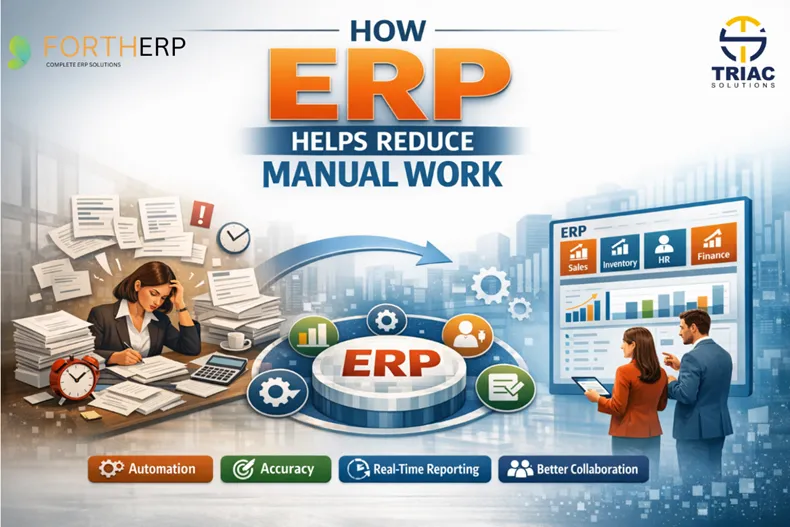
ERP (Enterprise Resource Planning) helps businesses manage all major activities such as sales, inventory, finance, HR, payroll, and customer management in one single system. Instead of entering the same information in different places, employees can update it once and access it everywhere.
Common Problems with Manual Work
When businesses rely on manual processes, they often face: • Re-entering the same data multiple times • Difficulty tracking inventory or employee details • Delays in approvals and reporting • Payroll and attendance errors • Missing documents and records • More time spent on routine tasks
These problems not only waste time but also reduce productivity.
How ERP Reduces Manual Work
1. Centralizes All Business Data
ERP stores all your business information in one place. Sales, accounts, inventory, HR, and payroll are connected in a single platform. Employees no longer need to search through files, emails, or different software systems.
For example, when a sale is entered into the ERP, the inventory, billing, and accounts are updated automatically.
2. Automates Repetitive Tasks
ERP software can automate many daily tasks that are usually done manually, including: • Creating invoices • Updating stock levels • Calculating payroll • Sending reminders • Approving leave requests • Generating reports
This reduces the amount of manual work and saves valuable time for employees.
3. Reduces Human Errors
Manual data entry often leads to mistakes such as wrong numbers, duplicate entries, or missing details. ERP reduces these errors because information is entered only once and shared across all departments automatically.
For example, payroll calculations are done automatically based on attendance and salary details, reducing the chance of mistakes.
4. Speeds Up Reporting
Preparing reports manually can take hours or even days. ERP systems provide real-time dashboards and instant reports for sales, expenses, employee attendance, inventory, and more.
Managers can make faster and better decisions because the data is always up to date.
5. Improves Team Coordination
Without ERP, departments often work separately, leading to communication gaps. ERP connects different teams so everyone works with the same information.
For example: • The HR team can see employee attendance instantly • The finance team can access payroll information directly • The sales team can check inventory before confirming an order
This avoids delays and improves teamwork.
Real Benefits for Businesses
By reducing manual work, ERP helps businesses: • Save time • Increase productivity • Reduce paperwork • Improve accuracy • Lower operating costs • Make faster decisions
Employees can spend less time on routine tasks and more time on important work that helps the business grow.
Conclusion
Manual work may seem manageable at first, but it becomes a major challenge as the business grows. ERP software helps businesses work faster, smarter, and more efficiently by automating daily tasks and connecting all operations in one place.
If your business is still spending too much time on spreadsheets and paperwork, it may be the right time to switch to an ERP system.